
Family Budget: 6 Costs of an International School in Morocco That Impact Your Year.
Choosing the right education for your children is one of the most significant financial decisions a family can make. However, when parents start their search for an International school in Morocco, they often focus solely on the advertised tuition fees. This is a classic mistake. Tuition fees often represent just the tip of the iceberg. To avoid unpleasant surprises mid-year and ensure a stress-free school year, it is crucial to analyse the budget in its entirety.
In a Montessori approach, where the environment and materials play a key role, understanding these investments is even more important. Here is a transparent breakdown of the real costs to help you plan effectively.
1. Tuition Fees: The Baseline of an International School in Morocco.
This is the figure everyone looks at first. Tuition fees cover pedagogical instruction, educator salaries, and the general operation of the establishment. At an International school in Morocco, these fees vary considerably by curriculum (French, American, British, or Montessori) and grade level.
It is important to verify the payment terms:
- Is payment monthly, quarterly, or annual?
- Are there discounts for siblings?
- Is there a planned annual increase?
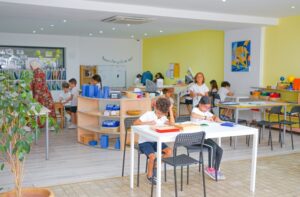
Note to Parents: Quality pedagogy, such as Montessori, requires a high supervision ratio (more adults per child), which often justifies higher tuition rates.
2. Registration and Entrance Fees: A High Starting Ticket.
Before your child even places their backpack in the classroom, administrative fees apply. You must distinguish between two types of costs when applying to an International school in Morocco.
First, there are Application Fees. Payable upon submission of the application, these are generally non-refundable.
Second, there are Entrance Rights (Development Fees). This is often a significant amount paid upon the very first enrollment. It serves to finance real estate investments and infrastructure maintenance.
Don’t forget the annual re-enrollment fees. Although lower than the first registration, they must appear in your family budget spreadsheet.
Contact our admissions team today for guidance and upcoming availability.
3. The School Canteen: More Than Just a Meal.
Nutrition is a fundamental pillar of a child’s concentration and development. In prestigious establishments, the canteen is not just a place to eat; it is a space for education regarding taste and health.
If you choose an International school in Morocco offering organic, balanced meals or food prepared by an on-site chef, the daily cost will be higher than a standard cafeteria.
- Check if the cost is a flat rate (annual) or per ticket.
- Ask if morning and afternoon snacks are included.
For a family with two children, this expense can represent several thousand dirhams per year.
To better understand how nutrition impacts learning, you can consult the Harvard School of Public Health’s guide to healthy eating for children:
Harvard School of Public Health – Healthy Eating for Kids
4. Transport to Your International School in Morocco.
With traffic density in major cities like Casablanca, Rabat, or Marrakech, school transport is often a logistical necessity for working parents.
The cost of transport for an International school in Morocco generally depends on the distance between your home and the establishment (zoning).
Questions to ask:
- Are the buses equipped with seat belts and air conditioning?
- Is there a monitor/assistant on the bus for the little ones?
- Is the service door-to-door or via collection points?
Although costly, this service offers safety and invaluable time-saving benefits for parents.
5. Extracurricular Activities: Fulfillment Has a Price.
Modern schooling doesn’t stop at 4:00 PM. A child’s fulfilment also involves sports, arts, robotics, or theatre.
Most schools offer an After-School Activity program. These activities are rarely included in the base tuition fees of an International school in Morocco.
Depending on the provider and the type of activity (piano costs more than football, for example), the bill can rise quickly. It is wise to budget for one or two activities per child per term.
6. Supplies, Uniforms, and Tech in an International School in Morocco.
Finally, the “small” costs that add up. Unlike the public system, a private International school in Morocco often requires a specific uniform. This includes everyday wear, sports kits, and sometimes specific winter attire. It is an initial cost, but it avoids the “brand war” in the morning. Then there is digital equipment. More and more schools require the purchase of a tablet (iPad) or a laptop starting from primary or middle school.
Checklist of ancillary costs:
-
Uniformes (Summer/Winter/Sport).
-
Textbooks (often imported).
-
Tablet or laptop.
- Field trips and class travel.
Conclusion: An Investment for the Future.
Calculating the total cost of an International school in Morocco can seem dizzying at first glance. However, it is essential to view these expenses not as a loss, but as a strategic investment.
A Montessori or international education offers your child open-mindedness, trilingualism, and the “soft skills” necessary for tomorrow’s world.
Transparency is key. By anticipating these real costs, you avoid financial stress and focus on what truly matters: your child’s fulfillment and success.